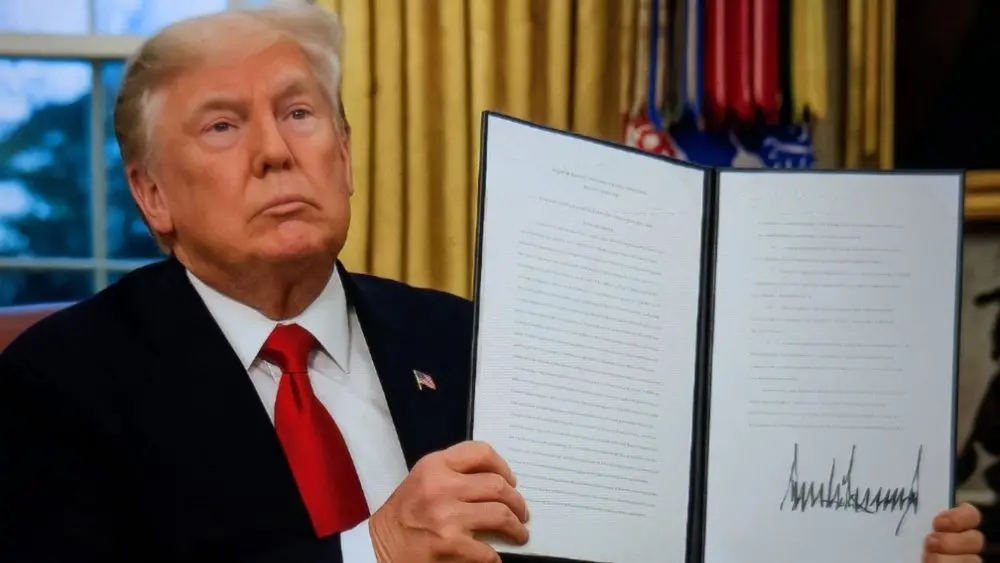
President Donald Trump on Thursday signed an executive order directing the federal government to move marijuana into a less restrictive drug category, marking one of the most consequential shifts in U.S. drug policy in decades. The order instructs Attorney General Pam Bondi to expedite the formal rescheduling process, which has been under review for more than a year, and to move toward issuing a final rule. For the first time at the federal level, the change formally acknowledges that marijuana may have medical value.
During a ceremony in the Oval Office surrounded by medical professionals, Trump announced the decision to move cannabis from Schedule I to Schedule III under the Controlled Substances Act, emphasizing medical considerations and patient advocacy: “Today I’m pleased to announce that I will be signing an executive order to reschedule marijuana from a Schedule I to a Schedule III controlled substance, with legitimate medical uses. We have people begging for me to do this. People who are in great pain.” He added that the support he received was overwhelming, noting, “I think I probably have received more phone calls on this, on doing what we’re doing — I don’t think I received any calls on the other side of it … For decades, this action has been requested by American patients suffering from extreme pain, incurable diseases, aggressive cancers, seizure disorders, neurological problems and more.”
Under federal law, Schedule I drugs are defined by the Drug Enforcement Administration as having “no currently accepted medical use and a high potential for abuse.” That category has long included marijuana alongside substances such as heroin, LSD and ecstasy. Schedule III, by contrast, applies to drugs considered to have a “moderate to low potential for physical and psychological dependence,” including medications such as Tylenol with codeine, ketamine, testosterone and anabolic steroids.
Marijuana has been classified as a Schedule I drug since 1970, even as state laws have evolved dramatically. Nearly all states now allow some form of medical use, and 24 states have legalized recreational marijuana. Although those laws conflict with federal statutes, recent administrations have generally refrained from targeting state-regulated cannabis operations.
While the shift could have significant practical effects, it does not legalize marijuana nationwide. Trump was explicit that recreational use remains illegal under federal law: “It doesn’t legalize marijuana in any way, shape or form or and in no way sanctions its use as a recreational drug. It’s never safe to use powerful controlled substances in a recreational manner.” A senior White House official underscored that point, saying, “Anyone possessing marijuana would be in violation of the CSA (Controlled Substances Act) and still remain subject to arrest under federal law. The schedule III change is not changing federal policy regarding that.”
Still, the move has drawn criticism from some Republicans. Earlier this week, 22 GOP senators urged Trump to keep marijuana in Schedule I, citing health concerns and potential impacts on workplace productivity and public safety. The lawmakers wrote: “we cannot reindustrialize America if we encourage marijuana use. In light of the documented dangers of marijuana, facilitating the growth of the marijuana industry is at odds with growing our economy and encouraging healthy lifestyles for Americans.”
Editorial credit: IAB Studio / Shutterstock.com